
Best Product Recommendation Quiz Apps for Shopify and Ecommerce in 2026 (9 Compared)

The best product recommendation quiz app is the one that turns five answers into the right serum for the shopper who would otherwise read three labels and leave, and that comes down to one mechanic: how the answers map to products. That mechanic splits the nine below into two families: native Shopify apps that read your catalog and recommend from it, and hosted quiz builders that embed on the store and map each outcome to a product link you choose by hand. I enjoy this one because once you know which family you’re in, the shortlist is two or three apps long, and the bill for 5,000 quiz takers a month usually picks between them.
The short list for a store that wants a product quiz live by Friday
- Hosted, any platform: Uplup, for the store that isn’t on Shopify or whose quiz is really a lead magnet, with outcome mapping and the results gate on every plan and Pro at $19 once the quiz passes 10 completions a month.
- Native, Shopify only: Lantern, the one I’d install first, because the free plan carries every feature up to 50 quiz takers a month and the paid ladder starts at $39 for 500.
- Native, four platforms: RevenueHunt, which also runs on WooCommerce, Magento and BigCommerce, with 100 completed quizzes a month free and a results page that adds to cart by default.
The mapping mechanic, and the six things behind it
It has to do one thing well, turn a set of answers into the right product, and six things well enough, so here’s what I scored, in the order I’d weigh it.
The mapping mechanic: every app on the list counts matches in some form. What I looked at is whether collections and tags can stand in for products, and what the shopper sees when nothing matched.
Catalog sync or manual links: a native app drops a sold-out item out of the results with one setting; a hosted builder shows the link you pasted until you change it.
Email and SMS capture: the email step should be a switch in front of the results, not a question you bolt on, with a path into Klaviyo or Omnisend, and four of the native apps take a phone number too.
Where it runs: a Shopify app, a script you paste anywhere, or both, and it’s the easy one to score.
How fast it goes live: with a template and a catalog connection you’re live in an afternoon, and with an AI draft from a prompt it’s minutes.
What it costs at volume: the unit each vendor meters (a start, a completion, a single answer, a lead) moves the bill at 5,000 takers more than the sticker does.
AI drafting from the catalog: I checked whether the app writes the questions and the mapping from your catalog or a description, and what that costs.
Every figure here comes off the vendor’s own pricing page, help center or App Store listing as it read on November 15, 2026, and the cost section is me redoing the arithmetic from those pages. When a page just doesn’t say (Lantern’s never mentions annual billing, for instance) I leave the gap showing instead of filling it.
Choose on the mapping mechanic first and let the feature list wait, because a quiz that recommends the wrong product behind a beautiful opt-in form is a very polite way to lose the sale.
How does a product recommendation quiz work?
A product recommendation quiz asks a shopper a handful of questions, scores each answer against your products or outcomes, and shows whatever scored highest on a results page, usually behind an optional email step. The whole thing is a weighted vote, and it needs less machinery than you’d think. Here’s how it works:
- The questions narrow the field: skin type, goal, budget, who it’s for, five to eight of them.
- The weights sit on the answers: a native app adds a vote to the linked products or tags, a hosted builder adds points to an outcome.
- The outcomes are the endings, whatever ranks first in the catalog or a results page you wrote.
- The product each outcome shows is pulled live from the store, stock included, or it’s a link you pasted.
- The email step sits before the results, optional or compulsory as you set it, and the answers travel with the address.
Step three is where I watch stores go wrong. A store that sells six products writes twelve outcomes because the template had twelve, and now two point at the same serum and four at nothing. Write one outcome per product you’d actually recommend, then the questions that separate their buyers (the build is in how to make a product recommendation quiz, step by step).
Native Shopify app or hosted quiz builder?
A native Shopify quiz app wins when the catalog changes faster than you’d edit a quiz, and a hosted builder wins when the store isn’t on Shopify or the quiz is a lead magnet first, and four questions settle which you are.
Catalog size and churn come first: under about 50 stable products, an outcome page per product is an afternoon’s work; above that, or with weekly launches, you want tags and collections doing the mapping. Add to cart is second, and it’s 100% a native job – RevenueHunt by default, Lantern with its variant dropdown, Quizell when embedded, and Octane AI, Prehook and Visual Quiz Builder through checkout integrations.
Stores outside Shopify narrow it fast, since only Quizell and RevenueHunt follow you to WooCommerce or Wix, and Uplup and Outgrow embed anywhere. Lead capture finishes it: if the email and the answers landing in Klaviyo matter more than stock levels, the hosted builder’s gate and CRM push are the whole point, the one place the mapping mechanic takes second billing.
Nine apps, side by side on the mechanics
Read the third column first, because it splits the list into its two families: six rows read the catalog, Uplup takes a link, Outgrow imports a product list, and Jebbit does both depending on the plan.
| App | Where it runs | How it maps answers to products | Email capture | Free plan | Monthly price |
|---|---|---|---|---|---|
| Uplup | Any page with a script; not in the App Store | Points to outcomes; each outcome links a product by hand | Results gate | 10 responses a month | $19 for 1,000 responses |
| Octane AI | Shopify | Rank rules on products, tags or collections; AI Smart Products | Klaviyo, Attentive, Postscript | None; 14-day trial | $50 for 400 starts |
| RevenueHunt | Shopify, WooCommerce, Magento, BigCommerce, standalone | Upvotes per choice on products or collections; add to cart | Email and phone; Klaviyo from Basic | 100 responses a month | $39 for 500 responses |
| Visual Quiz Builder | Shopify | Tagged products; perfect or most likely match | Optional email or SMS page | 1 quiz, 50 sessions a month | $30 for 500 sessions |
| Quizell | Shopify, Wix, WooCommerce, BigCommerce, Webflow, any site | One point per matched product, collection or vendor; AI Product Match | Lead forms; Klaviyo, Mailchimp, HubSpot | 24-hour pass | $15 for 500 starts |
| Prehook | Shopify | Include or Exclude votes per choice; Best Seller fallback | Email or SMS; Klaviyo, Attentive, Postscript | 10 engagements a month | $45 for 600 answers |
| Jebbit | Web, mobile, email, paid media, in-app | Products per outcome, or a feed (Shopify on Enterprise) | Forms into 150+ connectors | None on the live pages | Quote |
| Lantern | Shopify | Products or collections per answer; match counts and weights | Email and phone; Klaviyo, 80+ | 50 quiz takers a month | $39 for 500 takers |
| Outgrow | Embeds anywhere | Products from Shopify, RSS, Excel or by hand | Lead form; one native integration | Forms and surveys only | $45 for 1,000 leads |
The 9 best product recommendation quiz apps
Uplup opens the list as the hosted builder, the six catalog readers follow, and the enterprise platform and the content suite come last; read the middle as a tour rather than a ranking, since the native app I’d install first on a bare Shopify store is Lantern at number eight.
1. Uplup
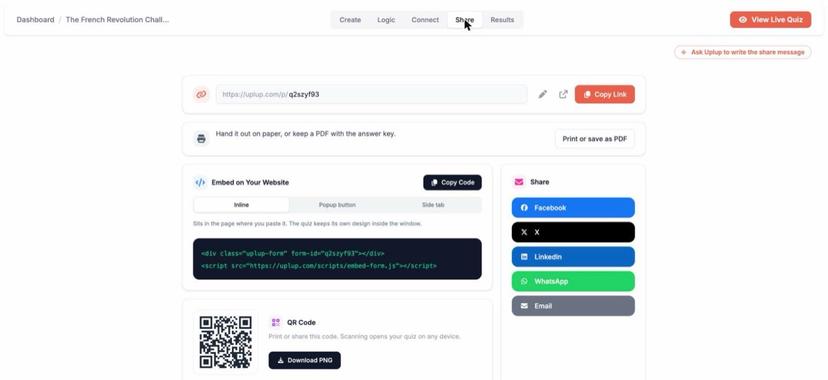
Uplup is a hosted quiz builder you embed with one script, so the quiz is a personality quiz with a lead gate in front and each outcome links to the product you choose by hand; it doesn’t read the Shopify catalog or add to cart, and it isn’t in the Shopify App Store. That shape honestly suits a store with a dozen products and a routine to sell.
Right for: brands whose answer is a routine, stores off Shopify, and any quiz that has to feed a CRM.
Cost (read November 15, 2026): Free is $0 for 10 responses a month with every scoring mode, lead capture, 1 AI generation and a “Made with Uplup” badge; the badge comes off on Pro at $19 for 1,000 responses, and Business is $49 a month or $490 a year for 10,000, then it’s $10 per 1,000.
How it recommends products comes down to outcome mapping on one screen:
- Pick the personality scoring mode and give each answer points toward one or more outcomes.
- Make each outcome a results page linking to the product or bundle you’d hand that shopper.
- Paste a product page URL into the product recommendation quiz builder and the AI drafts questions and outcomes.
Watch out for: a sold-out product stays in its outcome until you edit it, because nothing reads your stock; the upside is a quiz that’s live on a Webflow site the same day.
Bottom line: the pick when every name on the list should come with the product she wanted attached; a store policing forty SKUs’ stock should keep going down the list.
2. Octane AI
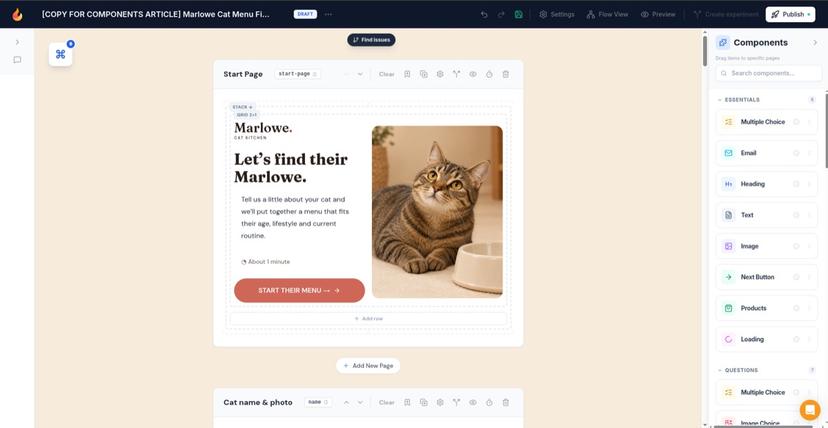
Octane AI says 5,000+ Shopify brands run it, and I believe it, because its Phoenix builder is the most complete recommendation engine here: rank rules, points, manual picks and an AI mode, all pointed at your live catalog.
Right for: Shopify brands with hundreds of SKUs and Klaviyo doing the heavy lifting afterwards.
Cost (read November 15, 2026): there’s no free tier, just 14 days of trial, and then Basic is $50 for 400 credits, one per quiz start, with the logo showing; the logo comes off at Plus.
How it recommends products runs on modes you can mix in one quiz:
- Auto from Rankings ties products, tags or collections to answers and nudges their rank by 1 or 10, or sets a Match / Exclude rule.
- AI Smart Products takes a prompt and picks from your Shopify catalog, and in-quiz AI features start from 0.04 credits a use, though there’s no fixed rate printed for Smart Products.
- Hide Out-of-Stock Products and Max Products sit on the results block, and from there the catalog polices the page.
Watch out for: the start is the unit, so the 1,500 shoppers who quit partway each spend a credit anyway. What you get for it is the nearest thing here to a quiz the AI builds end to end from your own catalog, and the assistant drafts it for no credits.
Bottom line: it’s the most machinery on the list, and it’s priced for a brand whose quiz already makes money.
3. RevenueHunt
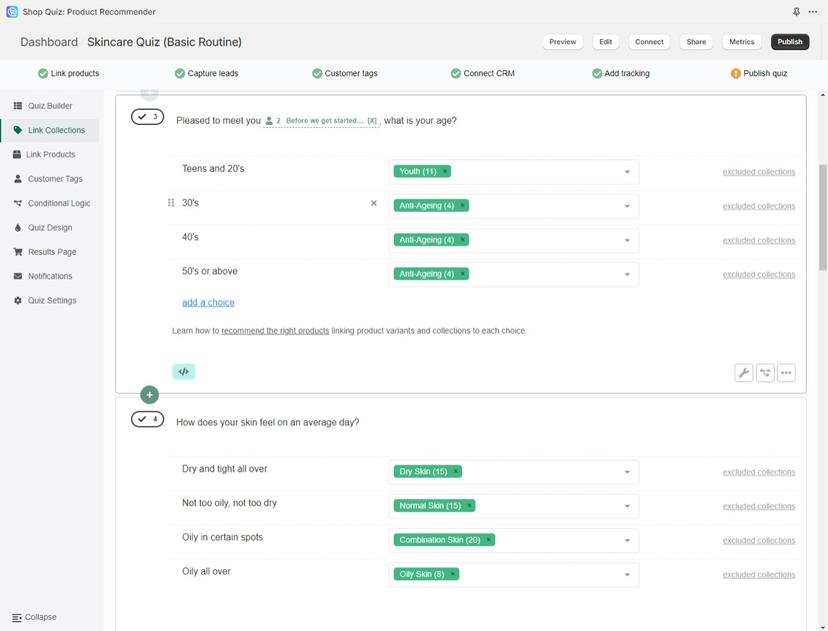
RevenueHunt makes the Product Recommendation Quiz (RH: Product Quiz Builder on the App Store), and it’s the one native app here that also installs on WooCommerce, Magento and BigCommerce.
Right for: multi-platform stores, and any Shopify store that wants add to cart from the results for free.
Cost (read November 15, 2026): Free is $0 for 100 responses a month, a response being a customer who reaches the results page, and you don’t get Klaviyo or Zapier until Basic at $39 for 500.
How it recommends products starts with an upvote and a catalog behind it:
- Link products or collections to each choice, and the results page shows the most-upvoted first.
- The sync imports tags, collections and variants daily; names, prices and images pull live from Shopify at render.
- Quiz Copilot writes the questions, choices and results copy, and links products to the choices.
Watch out for: every third-party integration is paid-only, so a free quiz sends its leads to Shopify Customers and a CSV and nowhere else. But, the results page adds to cart by default on Shopify, which is the part most stores end up wanting!
Bottom line: on a WooCommerce store it’s the one I’d install, and Quizell is the only other catalog reader that follows you there.
“Reads the catalog” buys you one thing above all: a results page that maintains itself. On Uplup you keep it honest by editing the outcome when a product sells out; on Octane AI and RevenueHunt a Hide Out-of-Stock setting does it for you (a checkbox on Octane AI’s results block, an inventory filter in RevenueHunt’s catalog settings), and a new product joins a collection and gets recommended without anyone opening the quiz. So native versus hosted is really a maintenance question – a twelve-product brand edits an outcome twice a year, and a weekly launcher feels it by month two.
4. Visual Quiz Builder
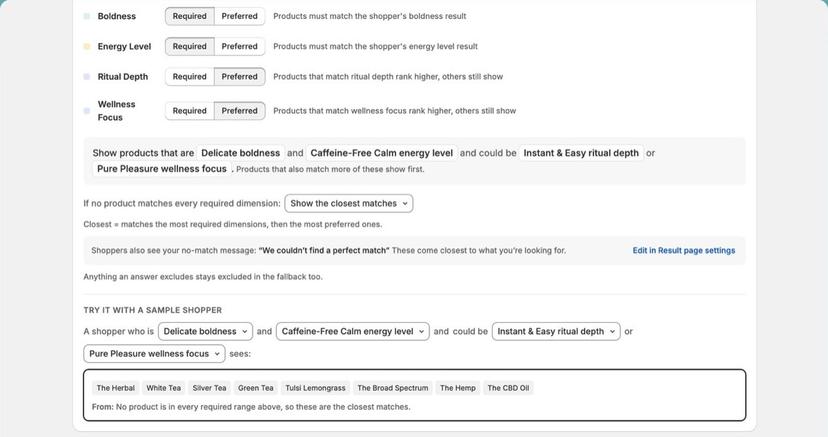
Visual Quiz Builder (VQB: AI Product Quiz Builder on the App Store) is the Shopify quiz builder that lets you choose how strict the match is, and that one setting changes what a shopper sees more than any design option.
Right for: Shopify stores with big catalogs where tagging beats linking products one by one.
Cost (read November 15, 2026): these come from the App Store listing, since its own pricing page wouldn’t load for me. Free is one quiz, five questions and 50 quiz sessions a month, and Convert at $30 for 500 is the entry.
How it recommends products rests on tags and a strictness switch:
- Tag products, variants or pages to the answers that should surface them, and weight the questions that matter more.
- Pick “Most likely match” for the highest-scoring products, or “perfect match” for products that fit every answer.
- Let the AI tag a big catalog for you, then switch the optional Email/SMS page on.
Watch out for: the listing never defines a quiz session, so I’ve counted one per start below, and I’d leave most likely match on, since I couldn’t find what perfect match shows a shopper whose answers fit nothing.
Bottom line: it’s the middle option at $30, and the strictness switch is the reason to take it over a plain vote count.
5. Quizell
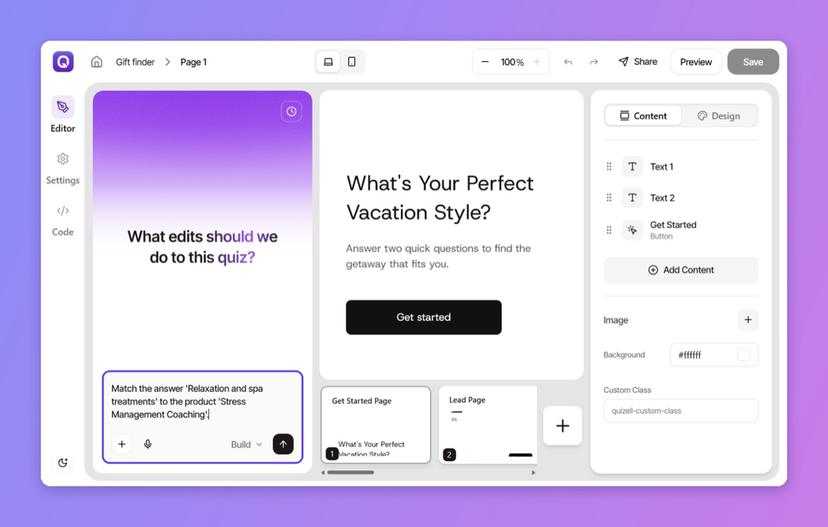
Quizell says it on its homepage, “Shopify-native. Not Shopify-only.”, and that’s the honest pitch: catalog matching that also runs on Wix, WooCommerce, BigCommerce, Webflow and any site you can embed on.
Right for: stores that want catalog matching off Shopify, or an AI to do the matching.
Cost (read November 15, 2026): the free offer is a 24-hour pass with one quiz, which means you’re picking a paid plan by day two. Lite is $15 for 500 starts and 250 products with the branding already off, and Pro is $199 a month or $1,990 a year for 20,000 starts and 4,000 products.
How it recommends products works as one point per match, with collections doing the upkeep:
- Open Settings > Product Match, click Manage Matches on an answer and pick products, collections or vendors.
- Each matched answer gives a product one point, and the results page ranks by total.
- AI Product Match reads titles, descriptions, prices and tags and maps up to 100 products in one pass.
Watch out for: 24 hours of free is a demo, and the product caps bite early, 250 on Lite and 1,000 on Plus at $49. Add to cart works when the quiz is embedded, so skip the direct link and put it on a page.
Bottom line: it brings Shopify-grade matching to a Wix or Webflow store, and telling the chat to match dry skin to the barrier cream and watching it just happen is a genuinely good idea.
6. Prehook
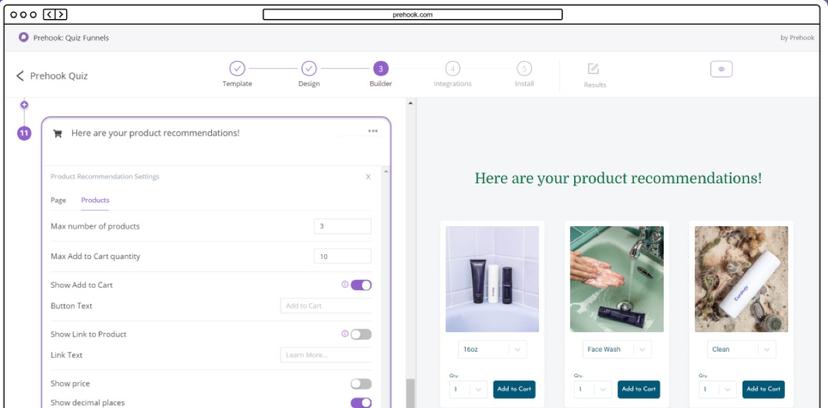
Prehook runs Quiz Funnels, a native Shopify app built around the funnel: a recommendation, an email or SMS capture while the shopper is still looking, and the answers pushed into Klaviyo, Attentive, Postscript or Omnisend.
Right for: Shopify stores whose SMS list matters as much as the sale.
Cost (read November 15, 2026): Free is $0 for 10 engagements a month, and an engagement is one answered question, in the FAQ’s own words: “Any time a customer answers one question in a quiz, it will count as an ‘engagement’.” Basic is $45 for 600 and Pro is $195 a month, or $129 billed yearly, for 6,000, then it’s $0.02 an answer.
How it recommends products is a vote count with a safety net:
- On the Product Recommendations tab, check Include or Exclude on products for each choice.
- Every included product gets one vote when its choice is picked, and the most-voted fill the results page.
- If no product got a vote, Prehook shows your Best Seller instead of an empty page.
Watch out for: the unit is the answer, and a seven-question quiz spends seven engagements per finisher; there’s also nothing on the pages that says AI writes the questions. The plumbing is good, though: a clicked recommendation lands in Klaviyo as a Custom Property.
Bottom line: it’s the app for a store that counts its SMS list as revenue, as long as the quiz stays short.
The mechanic that matters most is the one for when nothing matches, and the table has no column for it. All three count hits and show the top of the list, and on a normal run they land in the same place. They part ways on the shopper whose answers rule everything out, also the shopper most likely to leave: Prehook hands that person your best seller, Quizell shows whatever scraped one point, and Visual Quiz Builder’s pages leave that case open, which is why I’d keep most likely match on. So answer each demo quiz to contradict itself and look at what comes back.
7. Jebbit
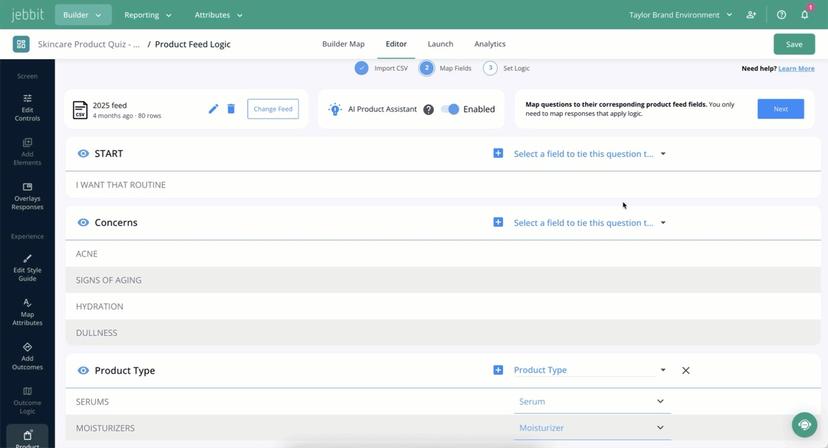
Jebbit now redirects to BlueConic, where it’s “Interactive Experiences (Formerly Jebbit)”, and it’s the enterprise end of this list: product finder quizzes across web, mobile, email, paid media and in-app. Its feed-plus-outcomes design is the one way among the nine to run 30 outcomes against a changing catalog without rebuilding the quiz.
Right for: brands with a CDP budget, a data team and more than 30 outcomes to manage.
Cost (read November 15, 2026): the live pages don’t print a price, a plan name or a free plan, and the only call to action is a demo request, which makes the price a conversation. Its Shopify listing, Jebbit: Quizzes That Convert, is marked “not currently available”, and the Shopify product sync sits on an Enterprise-level account.
How it recommends products is two systems you can run together:
- Outcomes with Products takes hand-entered products, up to 25 per outcome, reached by matching or scoring logic.
- Dynamic Product Feed filters by tags at display time, from a CSV on any plan or Shopify on Enterprise.
- AI Assist drafts titles, questions and results from your website; the AI product assistant picks from the feed.
Watch out for: none of it is self-serve, and a small store can’t try it this week.
Bottom line: it’s the right tool for a brand already talking to BlueConic, and a long way around for everyone else.
8. Lantern
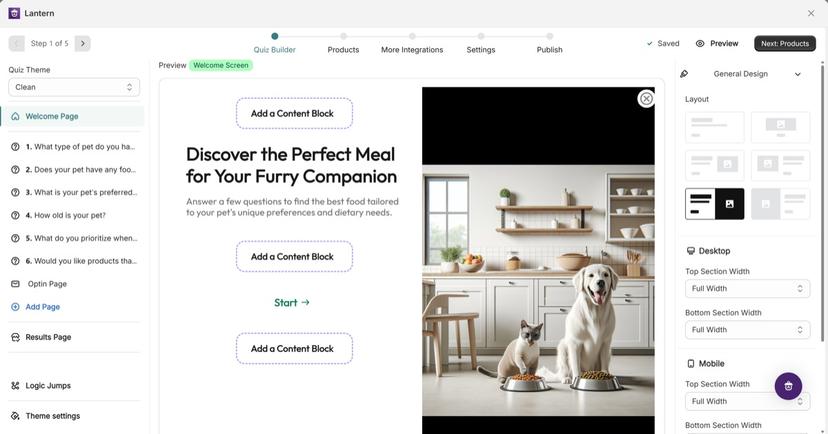
Lantern is a Built for Shopify quiz app by App Attic, and the one I’d hand a store owner with no budget, because the free plan is everything the paid plans have, up to 50 quiz takers a month, A/B testing included.
Right for: Shopify stores that want the catalog read on day one, with Ember, Lantern’s AI assistant, building the quiz by chat.
Cost (read November 15, 2026): Free is up to 50 quiz takers a month with every feature, and a taker is anyone who answered at least one question, not someone who just opened the quiz. Scale starts at $39 for 500 and moves you a tier up or down automatically each cycle, and the page doesn’t mention annual billing.
How it recommends products is match counting with the most knobs on this list:
- On the Products tab, each answer gets Matched Results and Excluded Products from products, variants or collections.
- Products matching more answers rank higher, shown as x/y, and answer weights default to 100 and go up to 10,000.
- Sorting Priority breaks ties by price, best selling or newest, and Default products cover a no-match.
Watch out for: it’s Shopify only, and the pricing page puts AI generation and MCP under Unlimited while saying every plan has every feature, so check your plan. The tier ladder moving on its own cuts both ways: a viral month moves your bill up, and a quiet one moves it back down.
Bottom line: it’s the native app I’d measure everything else against, and 50 free takers is enough to learn whether your shoppers finish.
9. Outgrow
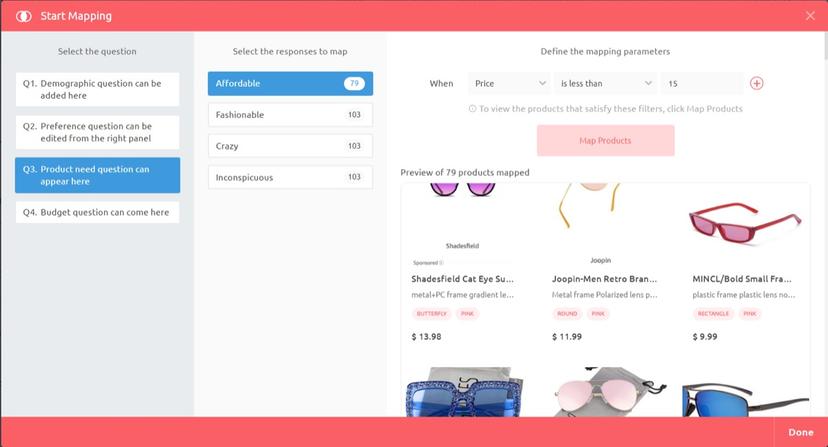
Outgrow sells interactive content by the suite, and eCommerce Recommendations is one content type in it next to calculators, outcome quizzes and chatbots; you bring the products in from Shopify, an RSS feed, an Excel file or by hand.
Right for: teams already running calculators in Outgrow that want a product finder alongside.
Cost (read November 15, 2026): the free plan is forms and surveys only, so eCommerce Recommendations starts on Freelancer Pro at $45 a month, or $25 billed annually, for 1,000 leads and one native integration. Essentials is $115, or $95 annually, for 7,500 leads, and the Outgrow badge stays on Essentials unless you qualify for the small-business incentive the page describes, with Business at $600 a month billed annually as the plan that drops it outright.
How it recommends products is the shortest list of the nine:
- Add products from Shopify, RSS, Excel or by hand, and each recommendation links to its product page.
- Ask the AI for more suggestions for the welcome screen, questions and results page.
Watch out for: I couldn’t get into Outgrow’s help center, which wants a login, so the logic above is what its pricing and feature pages say, and they say nothing about stock or sync for the Shopify import.
Bottom line: buy it when the calculators are the main event, and the product finder comes along for the ride.
5,000 shoppers, one quiz, nine bills
Take one quiz of seven questions and a month of traffic: 5,000 shoppers start it, 70% finish (3,500), 40% of the finishers leave an email (1,400), and the badge comes off wherever that’s a paid line. Each bill below is the first plan on the page that covers those numbers.
- Uplup’s unit is the response, meaning a finished quiz or form, so 3,500: Pro stops at 1,000, and that puts it on Business at $49 a month, or $490 on the yearly rate, call it $40.83.
- Octane AI counts starts, so 5,000: Plus at $350 covers 4,500 and the last 500 go at $0.0778 each, which is $38.90, so about $389 with Overages Protection on, or Enterprise at $500 for 7,250 if you’d rather not run overage.
- RevenueHunt counts customers who reach the results page, so 3,500: Premium’s 2,500 locks at 125%, which is 3,125, and the next step up is Enterprise from $299.
- Visual Quiz Builder counts quiz sessions, taken as starts, so 5,000: Personalize at $100 for 3,000 plus 2,000 at $0.04, so $180.
- Quizell counts starts, so 5,000: Plus stops at 4,000, and Pro at $199 a month or $1,990 a year is the next tier.
- Prehook counts answers, so 3,500 finishers times seven questions is 24,500, and that’s not counting whatever the 1,500 who quit answered: Pro’s 6,000 at $195, then 18,500 at $0.02, so $565.
- Jebbit is a quote, with the Shopify feed on Enterprise.
- Lantern counts takers who answered at least one question, so 5,000 at most: the 6,500 tier at $299.
- Outgrow counts lead-form submissions, so 1,400: Freelancer Pro’s 1,000 is short, and Essentials is $115 monthly or $95 billed annually.
Sorted on monthly billing, that’s $49, $115, $180, $199, $299, $299, $389, $565 and a quote for the same 5,000 shoppers, and the two annual rates on the list take Uplup to $40.83 and Outgrow to $95. A meter that pays you to ask fewer questions is a genuinely pretty thing, and Prehook’s is the only one here that does: cut the quiz from seven questions to five and 7,000 answers fall off the bill, $140 a month, while everywhere else the shorter quiz costs the same.
The completion meters pull the other way, and they’re kind to a quiz people abandon. Only the finish line counts on Uplup and RevenueHunt, which means the 1,500 shoppers who quit halfway cost nothing!
Which product quiz app for your store?
On Shopify the pick is one of the six that read the catalog (Lantern, RevenueHunt, Octane AI, Prehook, Visual Quiz Builder and Quizell), and off Shopify you want a hosted builder or one of the two natives that travel. Store by store, it goes like this:
- A Shopify store under 50 products starts on Lantern’s free plan, and moves to RevenueHunt if it ever leaves Shopify.
- A skincare or supplement brand with routines picks Uplup for an outcome-per-routine quiz with the gate on, or Octane AI once the catalog needs rank rules.
- A WooCommerce or custom site chooses Quizell for catalog matching or Uplup for an outcome quiz embedded the same day.
- An agency takes RevenueHunt for the platform spread, or Uplup’s workspaces when the clients are off Shopify and the deliverable is leads.
Frequently asked questions
Does Shopify have a built-in product quiz?
No, it doesn’t. There’s no quiz section in Shopify’s theme editor and none in the admin, which is why quiz apps sit in the App Store’s Pop-ups and Upsell and cross-sell categories. You add one with a native app such as Lantern, RevenueHunt, Octane AI, Prehook, Visual Quiz Builder or Quizell, or embed a hosted quiz with a script.
What is the best quiz app for Shopify?
Lantern, for a store starting from zero: the free plan is the full product up to 50 quiz takers a month, the first paid tier is $39 for 500, and the Products tab has more mapping knobs than any other app here. Octane AI fits a brand with hundreds of SKUs, and RevenueHunt fits a store on WooCommerce or BigCommerce.
How do you make a quiz on Shopify?
A Shopify product quiz starts with an app from the App Store: install it, link your products, collections or tags to the answers, and add the quiz to a page as a theme block or a popup. On a hosted builder you build the quiz, paste its embed script into a page, and point each outcome at a product URL.
How much does a Shopify quiz app cost?
As of November 15, 2026, Shopify quiz apps run from free plans at 10 to 100 responses a month to first paid tiers of $39 on Lantern and RevenueHunt, $45 on Prehook and $50 on Octane AI. For the 5,000-taker month the bills land between $49 and $565, and what each app counts does most of the spreading.
What makes a product quiz successful in ecommerce?
A quiz succeeds when the results page shows one confident recommendation that’s in stock, with a reason attached, after five to eight questions. The three things to get right are one outcome per product you’d actually recommend, a fallback for the shopper whose answers match nothing, and an email step placed before the results and made skippable.
Which simple quiz builders work for ecommerce sites?
For an ecommerce quiz off Shopify, Uplup maps outcomes to product links behind a results gate and runs on any site that takes a script, and Quizell brings catalog matching to Wix, WooCommerce, BigCommerce and Webflow. RevenueHunt installs natively on WooCommerce, Magento and BigCommerce, and its standalone version takes products from a Google Product Feed.
Start with three products
Pick your three best sellers, write down the one sentence that describes the person who buys each, and then write the five questions that would tell those three people apart. That’s the whole quiz, and a pen does it faster than any builder will. Build it on a free plan from the family you landed in, and on Uplup the 10 responses on the free plan are ten real shoppers’ worth of proof that the mapping sends each one to the right product, before a fourth product earns a fourth outcome.
